

Sommario
- 1. Why Industrial Production Layout Impacts Profitability
- 2. Waste Is Not Only About Raw Materials
- 3. Standard Systems vs Custom-Designed Industrial Systems
- 4. Production Flow Optimization
- 5. Industrial Ergonomics and Productivity
- 6. Maintenance Must Also Be Designed
- 7. Reducing Space Waste
- 8. Automation and Layout: Two Connected Elements
- 9. Designing Today for Future Growth
- 10. Conclusions
- 11. Want to discover how much your production layout can improve?
- 12. FAQ — Industrial Production Layout Optimization
- 12.1. 1. What is an industrial production layout?
- 12.2. 2. Why is production layout important?
- 12.3. 3. What are the advantages of custom-designed industrial systems?
- 12.4. 4. Are standard industrial systems less efficient?
- 12.5. 5. How can production flows be optimized?
- 12.6. 6. How does industrial ergonomics affect productivity?
- 12.7. 7. Is it possible to increase production without expanding the facility?
- 12.8. 8. What is the role of industrial automation in production layouts?
In today’s industrial world, many companies invest in new machinery believing that productivity depends only on installed technology. In reality, one of the most critical factors affecting plant efficiency is often overlooked: the industrial production layout.
Even highly advanced equipment can generate delays, waste, and hidden costs when installed inside a poorly organized facility. On the other hand, intelligent layout planning and optimized production flows can significantly increase operational capacity without expanding the plant.
For this reason, more and more companies are choosing custom-designed industrial systems built around real production needs instead of adapting production processes to standard equipment.
Why Industrial Production Layout Impacts Profitability
Production layout is often considered simply a matter of machine positioning. In reality, it is a strategic decision that directly affects:
- productivity
- operating costs
- safety
- ergonomics
- product quality
- maintenance efficiency
- future scalability
Every poorly utilized square meter creates inefficiency. Every unnecessary operator movement results in lost time, increased fatigue, and lower productivity.
In the food processing industry, where hygiene, speed, and production continuity are essential, these aspects become even more critical. To explore modern industrial digitalization technologies in greater depth, it is also useful to consult an in-depth overview of Industry 5.0.
Waste Is Not Only About Raw Materials
When discussing industrial waste, companies usually think about:
- discarded products
- energy consumption
- water usage
- raw materials
However, one of the most expensive forms of waste is often invisible: wasted movement and wasted space.
Operators forced to walk long distances, oversized piping systems, fragmented production lines, and poorly positioned storage areas all reduce efficiency and increase hidden operational costs.
Over time, these inefficiencies impact:
- cycle times
- energy consumption
- maintenance efficiency
- workforce management
- equipment wear
A properly designed production layout drastically reduces these issues
Standard Systems vs Custom-Designed Industrial Systems
Many companies purchase standardized equipment to reduce initial investment costs or speed up installation. However, standard systems rarely match the real characteristics of a production facility.
Every industrial process has unique requirements, including:
- different available spaces
- unique logistics flows
- variable product types
- different automation levels
- future expansion needs
Adapting a production process to a standard system often creates operational compromises that become increasingly visible over time.
The most common consequences include:
- inefficient production paths
- increased manual handling
- difficult maintenance access
- limited scalability
- poor space utilization
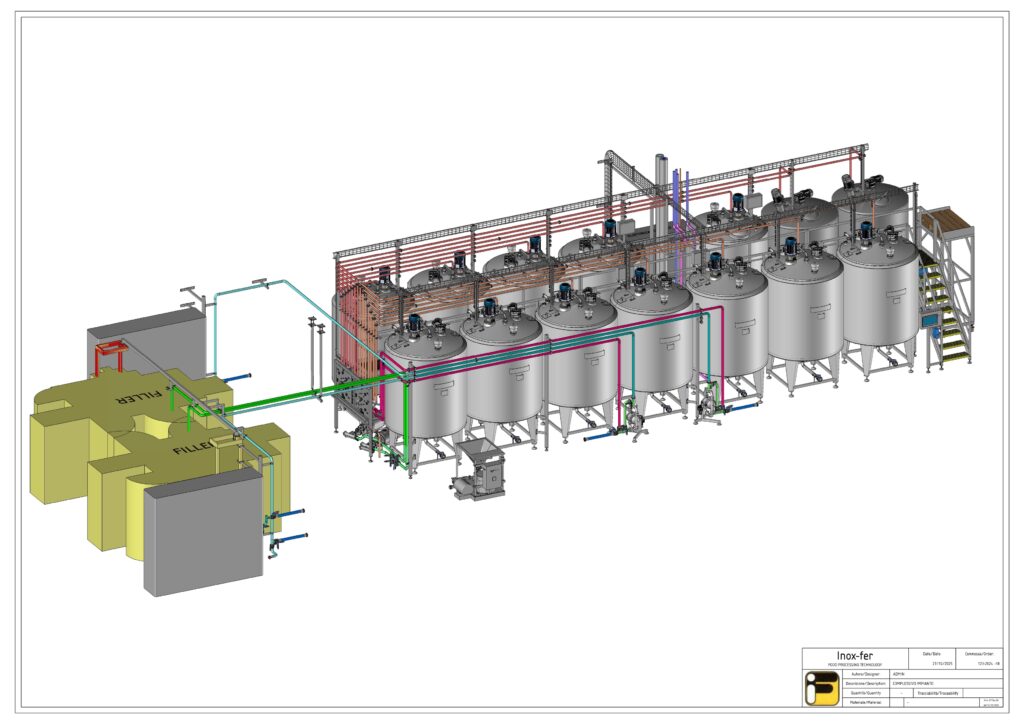
Custom stainless steel industrial systems are instead designed starting from a complete analysis of the production process and facility requirements.
Production Flow Optimization
An efficient plant is a facility where the product moves smoothly without interruptions.
This principle is especially important in the food & beverage industry, where production interruptions can compromise:
- product quality
- food safety
- production timing
- shelf life
An optimized industrial layout creates continuous and linear workflows between:
- preparation
- processing
- thermal treatment
- storage
- packaging
- sanitation
Reducing intersections between operators, raw materials, and finished products improves both production speed and hygiene safety.
For food companies, it is also important to comply with FDA food safety standards required by international markets.
Industrial Ergonomics and Productivity
Industrial ergonomics is not only about operator comfort. It directly affects operational profitability.
Poorly designed systems force operators to:Un impianto progettato male obbliga il personale a:
- perform unnecessary movements
- work in uncomfortable conditions
- manage manual handling tasks
- operate in difficult-to-access spaces
Over time, this leads to:
- slower operations
- increased risk of errors
- higher fatigue levels
- more production downtime
Custom industrial systems allow every production area to be designed around real operational activities and workforce needs.
To explore this topic further, it is also possible to consult industrial ergonomics guidelines.
Maintenance Must Also Be Designed
One of the most common mistakes in industrial plant design involves maintenance accessibility.
Many systems are installed without considering:
- component accessibility
- technical spaces
- easy disassembly
- cleaning times
- CIP management
This often generates high maintenance costs and extended downtime.
Custom-designed systems simplify:
- routine maintenance
- sanitation procedures
- inspections
- component replacement
In food processing industries, where hygiene standards are essential, this becomes a strategic advantage.
Reducing Space Waste
Many companies believe that increasing production capacity always requires expanding the facility
In reality, the issue is often inefficient space utilization.
Custom plant engineering makes it possible to:
- integrate multiple functions into compact skid systems
- develop vertical production layouts
- reduce line lengths
- optimize utilities
- centralize control systems
This increases productivity while maintaining the same plant footprint.
Automation and Layout: Two Connected Elements
Today, industrial automation and production layout cannot be separated.
PLCs, Industry 4.0 software, smart sensors, and remote monitoring systems help reduce:
- human errors
- downtime
- operator dependency
- energy consumption
However, automation only performs efficiently when integrated into a properly designed production layout.
Even the most advanced software loses effectiveness if the physical production flow remains inefficient.
Modern industrial automation solutions now allow companies to monitor and optimize every stage of the production process.
Designing Today for Future Growth
One of the greatest advantages of custom-designed systems is scalability.
Industrial companies evolve quickly. Change:
- Production volumes
- Markets
- Recipes
- packaging
- regulations
A rigid production layout can become obsolete within a few years.
Custom industrial systems allow companies to build modular structures ready for future expansions without redesigning the entire facility.
Conclusions
Optimizing an industrial production layout does not simply mean rearranging machinery. It means redesigning the way a company creates value.
Custom-designed industrial systems are now a strategic solution for reducing waste, improving efficiency, and preparing facilities for future challenges.
In increasingly competitive markets, success depends not only on installed technology, but on how efficiently every part of the production process works together.
Want to discover how much your production layout can improve?
Contact Inox-Fer for a personalized technical consultation and learn how to reduce waste, optimize space, and improve your plant efficiency.
FAQ — Industrial Production Layout Optimization
1. What is an industrial production layout?
An industrial production layout is the strategic organization of machinery, production lines, storage areas, and operational flows within a manufacturing facility. An efficient layout improves productivity, safety, ergonomics, and operational efficiency.
2. Why is production layout important?
A well-designed production layout helps companies:
- optimize workflows
- reduce downtime
- minimize operator movement
- improve safety
- increase productivity
- simplify maintenance and sanitation
Poor layouts often increase operational costs and reduce efficiency.
3. What are the advantages of custom-designed industrial systems?
Custom industrial systems allow companies to:
- maximize available space
- improve ergonomics and workflows
- integrate automation technologies
- simplify future expansions
- increase production efficiency
- reduce operational waste
4. Are standard industrial systems less efficient?
Not always, but standard systems often require compromises that reduce layout efficiency. Every facility has different production needs, and custom engineering usually provides better long-term performance.
5. How can production flows be optimized?
Production flow optimization includes:
- reducing workflow intersections
- creating linear product paths
- integrating machinery efficiently
- automating product transfers
- improving workstation positioning
- minimizing manual handling
This improves productivity, safety, and operational continuity.
6. How does industrial ergonomics affect productivity?
Industrial ergonomics directly impacts operational performance by reducing:
- operator fatigue
- human errors
- intervention times
- workplace safety risks
At the same time, it improves comfort and daily productivity.
7. Is it possible to increase production without expanding the facility?
Yes. Many companies increase production capacity by optimizing their existing layout through:
- compact systems
- vertical integration
- better space management
- process automation
- improved production organization
8. What is the role of industrial automation in production layouts?
Industrial automation allows companies to:
- monitor processes in real time
- reduce human error
- improve speed and precision
- decrease downtime
- optimize space utilization
Today, PLCs, Industry 4.0 software, and smart systems are essential components of modern industrial plants.