Skip to content

CE Certification for Food Processing Plants: Regulations and Compliance

Regulatory Framework for CE Certification in Industrial Food Systems

CE certification for industrial food processing plants is an essential requirement for placing machinery, automated process lines, and stainless steel systems on the European market. In the food & beverage industry, CE marking confirms that industrial equipment has been designed and manufactured in compliance with applicable European regulations concerning safety, hygiene, operational reliability, and operator protection.

Within industrial food plants, CE compliance is not merely an administrative procedure. It is an integrated engineering requirement that directly affects plant design, process architecture, automation systems, and hygienic construction standards from the earliest development stages.

Key technical aspects include:

  • Mechanical and electrical engineering design
  • Verification of food-contact materials
  • Compliance assessment with applicable EU Directives
  • Technical documentation and technical file preparation
  • Integration of safety and process control systems

For official guidance on CE marking, refer to the European Commission portal:
CE Marking – European Commission

European Regulations for CE Certification of Food Processing Plants

CE compliance in the food processing industry results from the combined application of several European regulations and directives. Applicable requirements vary depending on the type of industrial plant, automation level, and presence of pressure equipment.

The primary European regulations include:

  • Machinery Directive 2006/42/EC
  • Pressure Equipment Directive (PED) 2014/68/EU
  • Regulation (EC) No 1935/2004 for food contact materials (MOCA)

Machinery Directive 2006/42/EC

The Machinery Directive defines the essential health and safety requirements for industrial machinery and interconnected automated systems.

It applies to:

  • Mechanical guarding systems
  • Emergency stop systems
  • Moving parts safety
  • Control logic and automation
  • Integration of industrial process systems

Official documentation:
Machinery Directive 2006/42/EC
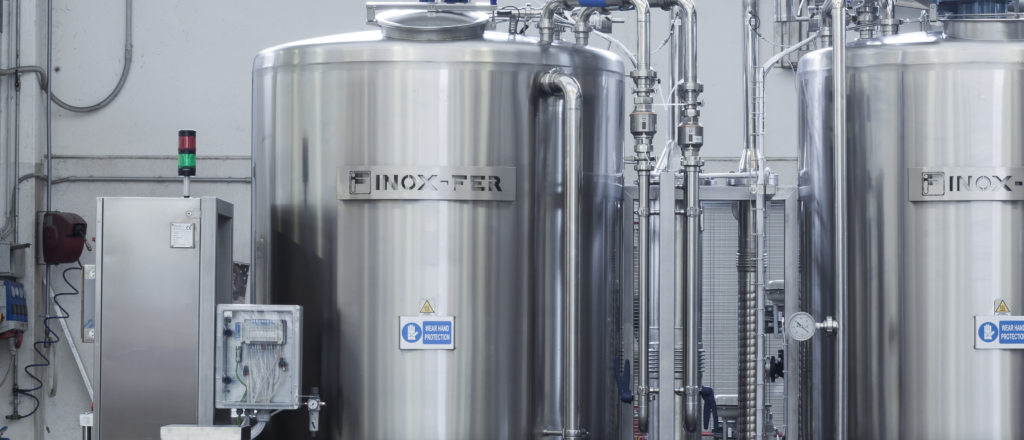
Stainless steel plant with CE certification for food-processing systems, including tanks and industrial process lines.

Pressure Equipment Directive (PED) 2014/68/EU

The PED regulates pressure equipment widely used in industrial food processing plants.

Typical applications include:

  • Stainless steel food-grade tanks
  • Autoclaves
  • Sterilization systems
  • Heat exchangers
  • Pressurized cooking systems

Official regulation:
Pressure Equipment Directive 2014/68/EU
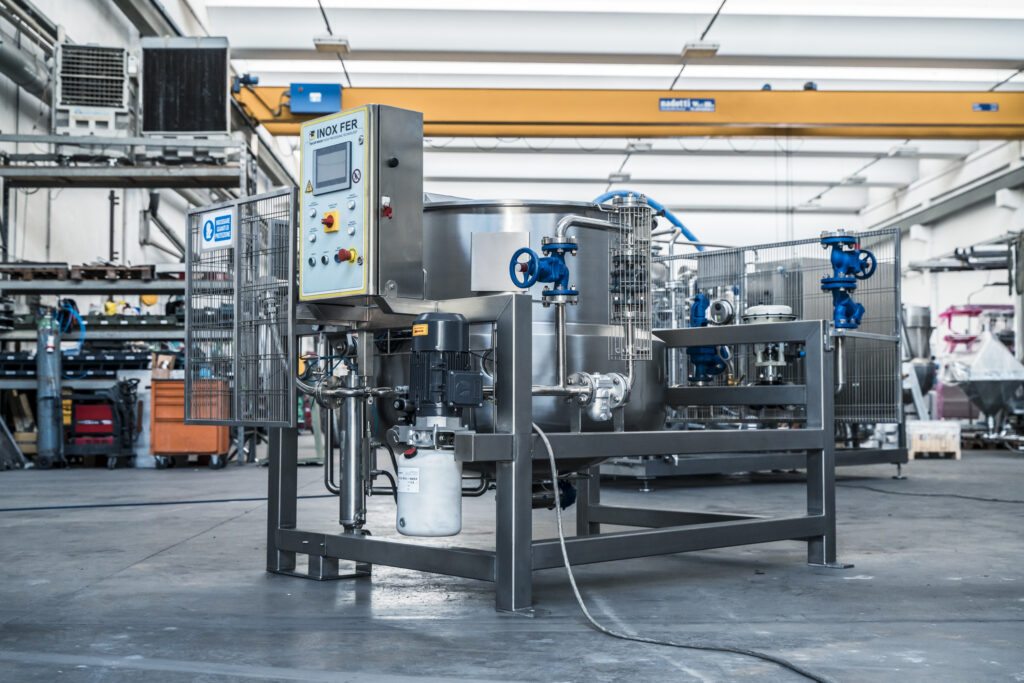
PED pressure equipment for industrial food-processing plants

MOCA Regulation 1935/2004

Regulation (EC) No 1935/2004 establishes requirements for materials and articles intended to come into direct or indirect contact with food products.

It applies to:

  • Food-grade stainless steel
  • Gaskets and seals
  • Technical polymers
  • Surface coatings
  • Process components

Official regulation:
Regulation (EC) No 1935/2004

Read our in-depth article on MOCA

Other directives

Additional directives related to Low Voltage (LVD) and Electromagnetic Compatibility (EMC) are also essential for automated food processing systems.

Integration of CE Marking into Food Plant Engineering

In stainless steel food processing systems and industrial process plants, CE certification is fully integrated into engineering and plant design activities. Compliance requirements directly influence:

  • Plant architecture
  • Selection of mechanical and electrical components
  • Functional safety interfaces
  • Technical documentation and technical file management

In complex food processing plants — including mixing, thermal treatment, and cooking systems — CE marking is closely interconnected with PED compliance for pressure-related sections of the installation.

Scope of CE Marking in Industrial Food Plants

CE marking is mandatory for machinery intended for the food industry whenever the equipment qualifies as:

  • A standalone machine
  • An assembly of interconnected machines
  • An automated processing line

Typical industrial food applications include:

🔹Process Systems

  • CIP/SIP cleaning and sanitization systems
  • Dosing and mixing plants
  • Product transfer systems

🔹 Pressure Equipment

  • Stainless steel food-grade vessels
  • Autoclaves and sterilizers
  • Pressurized cooking systems

🔹 Specialized Food Processing Machinery

  • Powder dissolvers
  • Industrial mixers
  • Automated packaging systems

CE Compliance, Functional Safety, and Manufacturer Responsibility

The manufacturer of the industrial food plant is legally responsible for CE compliance and must ensure:

  • Risk assessment according to harmonized standards
  • Design compliance with applicable EU directives
  • Preparation of the technical file
  • Issuance of the EC Declaration of Conformity

Where required by the risk category, a notified body must be involved. Authorized European notified bodies can be verified in the official EU database:

📌 https://ec.europa.eu/growth/tools-databases/nando/

Relationship Between CE Marking and PED Compliance

In industrial food processing systems, CE marking and the Pressure Equipment Directive operate in a complementary manner:

  • CE marking → overall conformity of the machine or processing plant
  • PED compliance → safety of pressure equipment components

This distinction is particularly important in complex food manufacturing systems, where machinery safety and pressure-system safety must be evaluated under separate but integrated regulatory frameworks.

Final Considerations

CE certification for industrial food processing plants is a structural component of the engineering and manufacturing process rather than a final administrative step.

In the food & beverage sector, proper CE implementation ensures:

  • Operational safety
  • Compliance with European regulations
  • Reliability of industrial production processes
  • Legal access to the EU market

Do you need to design or certify a food-processing plant compliant with European regulations?

Contact us for technical consultancy on CE marking, the PED Directive, and plant engineering for the food & beverage industry.

FAQ – CE Certification for Industrial Food Processing Plants

CE certification is the declaration of conformity confirming that an industrial food processing plant has been designed and manufactured according to applicable European directives, ensuring safety, hygiene, and suitability for food & beverage production.

CE marking is mandatory when the equipment is:

  • A machine or assembly of machines
  • Intended for food production or processing
  • Equipped with electrical or mechanical systems
  • Designed for direct or indirect food contact

The main European regulations are:

  • Machinery Directive 2006/42/EC
  • Pressure Equipment Directive (PED) 2014/68/EU
  • Regulation (EC) No 1935/2004 for food contact materials

These regulations work together to ensure overall plant safety and compliance.

CE certification concerns the overall conformity of the industrial plant, while PED specifically regulates equipment operating under pressure, such as tanks, autoclaves, and industrial cooking systems.

The plant manufacturer is legally responsible and must:

  • Perform risk assessment
  • Design according to EU directives
  • Prepare the technical file
  • Issue the EC Declaration of Conformity

In some cases, involvement of a European notified body is mandatory.

Yes. Industrial food processing plants made of stainless steel generally fall within CE marking requirements when classified as machinery or automated process systems for food production.

CE marking guarantees machinery and process safety. Food safety itself is additionally regulated through MOCA legislation and sector-specific hygiene regulations.

Official European notified bodies are listed in the European Commission database: NANDO Database

https://ec.europa.eu/growth/tools-databases/nando/

Because it ensures that industrial food processing plants are:

  • Safe for operators
  • Compliant with EU regulations
  • Suitable for food production
  • Legally marketable within the European Union