

Sommario
- 1. What does the PED cover in a food processing plant?
- 2. When is PED CE marking required?
- 3. What should a food manufacturer ask its equipment supplier?
- 4. Are PED and food contact compliance the same thing?
- 5. Plan pressure requirements alongside the process
- 6. FAQ – Frequently asked questions on PED certification for food processing equipment
- 7. Author
Author: Matteo Morotti, Process Engineer at INOX-FER
Does every stainless steel food processing machine need PED certification? No. The answer depends on its pressure boundaries, maximum allowable pressure, design parameters and the way the equipment is supplied. A steam heated cooking system, for example, may contain several circuits that need to be considered separately.
The Pressure Equipment Directive—Directive 2014/68/EU—applies to qualifying stationary pressure equipment and assemblies with a maximum allowable pressure (PS) greater than 0.5 bar. That threshold begins the assessment; it does not determine the equipment’s category or automatically require PED CE marking.
What does the PED cover in a food processing plant?
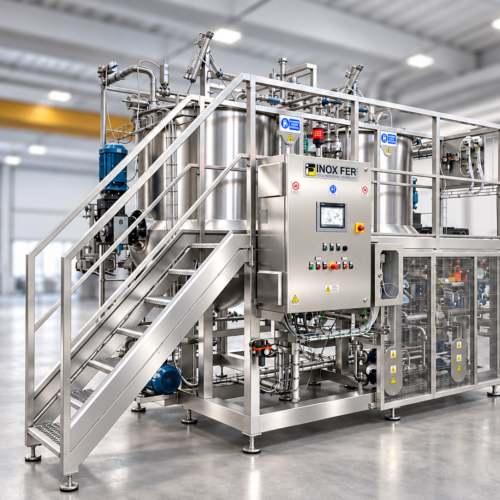
The PED establishes requirements for the design, manufacture and conformity assessment of pressure equipment placed on the EU market. Depending on their design, relevant items in a food plant can include vessels, piping, pressure accessories, safety accessories and assemblies.
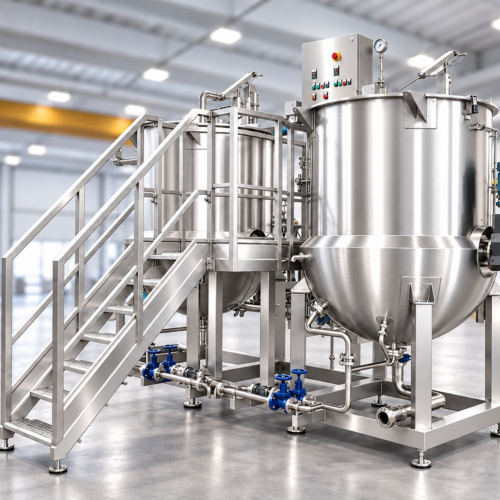
Potential applications include a pressurised mixing vessel, the heating jacket of an industrial cooker, a heat exchanger or pipework carrying a pressurised process fluid. The fact that a machine is made from stainless steel—or used to produce food—does not establish its PED classification.
Does a vacuum cooker automatically fall under the PED?
No. A vacuum process creates pressure below atmospheric pressure in the product chamber; it does not automatically mean that the chamber requires PED conformity assessment. A separate steam or hot water circuit serving the same machine may have its own positive pressure design conditions and require assessment.
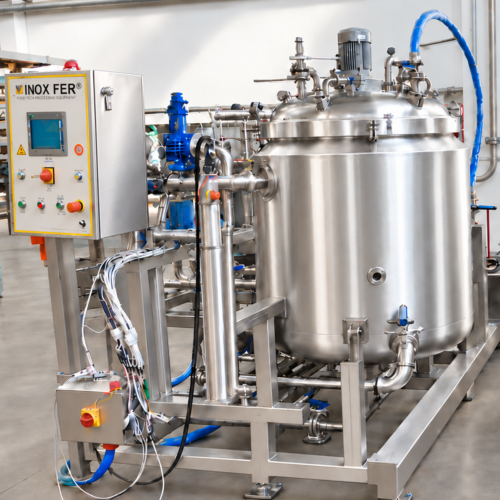
A practical example: INOX-FER’s concentration kettles can use vacuum processing to concentrate foods such as sauces and jams. When reviewing a particular configuration, the engineer identifies the product chamber, heating circuit, connected piping and safety devices, then checks the design conditions of each relevant pressure boundary. The PED conclusion must be based on that configuration—not simply on the description “vacuum kettle”.
When is PED CE marking required?
A maximum allowable pressure above 0.5 bar does not mean that every item receives CE marking under the PED. The directive also provides for equipment manufactured according to sound engineering practice when it falls below the relevant category thresholds. Such equipment must be designed and manufactured to ensure safe use, but it does not carry CE marking under the PED. The completed machine may require CE marking under other applicable EU legislation.
Equipment classified in Categories I to IV follows a conformity assessment procedure appropriate to its category. Once the applicable requirements have been met, the manufacturer draws up the EU declaration of conformity and applies CE marking. Some procedures require the involvement of an EU notified body.
How is the PED category determined?
Classification considers the type of equipment and relevant design parameters, including:
- maximum allowable pressure (PS);
- vessel volume (V) or piping nominal size (DN);
- the fluid’s group and physical state;
- the applicable classification table in the directive.
Pressure alone cannot establish whether a vessel belongs to Category I, II, III or IV. For an integrated assembly, the equipment and its integration must also be assessed according to the applicable PED provisions.
What should a food manufacturer ask its equipment supplier?
PED questions are most useful at the specification stage, while the process and utilities can still be clearly defined. Ask:
- Which parts of the proposed system form a pressure boundary?
- What are their maximum allowable pressure and temperature?
- What classification and conformity assessment route apply?
- Which safety accessories are included in the scope of supply?
- Which declarations, instructions and technical documents will be supplied?
These questions help distinguish the pressure requirements of the product vessel from those of a steam jacket, heating circuit or connected pipework. They also clarify who is responsible for the conformity assessment of an integrated assembly.
Are PED and food contact compliance the same thing?
No. PED addresses pressure safety; food contact requirements address materials and objects intended to contact food. Both may matter in the same machine, but they assess different risks. Selecting AISI 304 or AISI 316 stainless steel alone does not establish complete conformity with either set of requirements.
For more on the food contact side, read INOX-FER’s guide to MOCA requirements. The legal source for pressure equipment is the full text of Directive 2014/68/EU; the European Commission’s PED page also links to guidance and the EU database of notified bodies.
Plan pressure requirements alongside the process
A cooking or mixing system must satisfy the production brief and the requirements applicable to its final design. Defining fluids, pressures, temperatures, capacities and equipment boundaries early gives the engineering team the information needed to assess pressure safety correctly.
INOX-FER designs industrial cooking systems and complete food processing plants for specific production needs. Contact INOX-FER to discuss the process conditions and documentation required for your project.
FAQ – Frequently asked questions on PED certification for food processing equipment
1. Is PED certification mandatory for every food processing machine above 0.5 bar?
No. A maximum allowable pressure above 0.5 bar triggers a check of the directive’s scope. The equipment’s characteristics, any applicable exclusions and its classification determine the subsequent requirements. Equipment under sound engineering practice does not carry CE marking under the PED.
2. Is the steam jacket of a cooker assessed separately from its product vessel?
The two can have different fluids and design conditions. Their pressure boundaries must be identified before the manufacturer determines the applicable assessment for the supplied equipment or assembly.
3. Who issues the EU declaration of conformity?
The manufacturer issues the EU declaration of conformity when the required assessment demonstrates compliance. A notified body participates when the selected procedure requires one; its involvement does not transfer the manufacturer’s responsibility.
Author

Matteo Morotti is a Process Engineer at INOX-FER, an Italian manufacturer of stainless steel process equipment for the food industry. He contributes an engineering perspective to articles on food processing systems and the technical requirements that influence equipment design.