Skip to content

Food Process Scale-Up: From Recipe to Industrial Production. How to Increase Batch Size While Maintaining Product Quality.

A sauce developed in the laboratory may have the desired texture, uniform colour and ingredient balance. Producing a larger batch requires the same characteristics to be achieved consistently, within the time and operating constraints of the factory.

Food process scale-up transfers a recipe and its processing method from laboratory or pilot batches to industrial production. To maintain product quality, manufacturers need to define the required product characteristics, assess mixing and thermal processing at the new scale, and verify the result through agreed trials.

This guide explains the information to collect, the process stages to assess and the trials to plan before selecting food processing equipment. It is intended for production managers, food technologists, R&D teams and engineers preparing to launch a product or increase output.

What changes when a food recipe moves to industrial production

Keeping ingredient percentages constant establishes the starting formulation. The processing conditions must then be assessed for the larger quantity. Vessel geometry, agitation and heat transfer can require different settings from those used in the laboratory.

Successful food process scale-up starts with the finished product specification.

The manufacturer and equipment supplier use that specification to determine the operating conditions and equipment configuration to assess.

Which product data should be defined before selecting equipment

Before discussing capacity or accessories, R&D, production and engineering should agree the product acceptance criteria. Descriptions such as “creamy” or “uniform” should be supported, wherever possible, by measurements and comparison methods.

An initial process brief should include:

  • formulation and raw material characteristics;
  • ingredient addition sequence;
  • minimum and maximum batch sizes;
  • temperatures and times for each processing stage;
  • target consistency and the measurement method;
  • particles or pieces that must retain their structure;
  • required daily output and frequency of recipe changes;
  • transfer and filling conditions.

Viscosity measurements, for example, are comparable only when the test conditions are specified, including temperature and the measurement method. Sampling time also matters: a freshly processed product may differ from the same product after cooling or storage.

These details help the supplier assess the application and allow the buyer to compare equipment proposals against the same production requirements.

Which processing stages should be checked during scale-up

Mixing and ingredient distribution

Mixing must ensure uniform distribution with an intensity suited to the product: a smooth cream and a sauce containing pieces require different mixing actions. Trials should compare uniformity, consistency and ingredient integrity. INOX-FER mixing systems should therefore be assessed according to the recipe, batch sizes and integration into the process.

Powder incorporation and dispersion

For starches, proteins and thickeners, check the liquid temperature, ingredient addition sequence and feed rate. The absence of lumps in the mixture does not, on its own, confirm that the ingredient has dissolved or hydrated correctly.

Heating and cooling

Recording temperatures and times helps assess thermal processing at the larger scale. Viscosity and solids content influence heat transfer and heat exchanger selection, which must support the required product characteristics.

Transfer and filling

Checks should include discharge and transfer through pumps and pipework, assessing consistency, temperature on arrival and product remaining in the circuit. Any waiting periods before filling should also be considered.

An illustrative example of scaling up a creamy sauce

Consider a sauce developed in 10 kg batches and intended for production in 300 kg batches. These quantities describe an illustrative scenario; they are not an INOX-FER customer result or a stated machine capacity.

The formulation contains a liquid base, a fat component and a thickener. The reference product has a uniform consistency and shows no separation under the intended storage conditions.

Before transferring the process, the team should agree how to compare the laboratory reference with the larger batch.
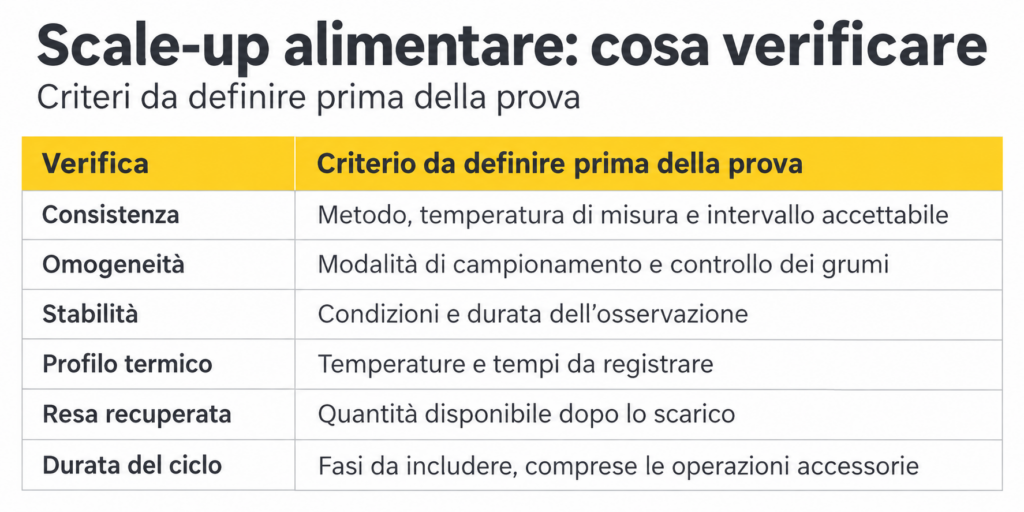
Food Process Scale-Up Criteria: What Needs to Be Checked

Trials can then assess the loading sequence, dispersion conditions and processing settings. If the results differ, investigate the causes before changing the formulation or confirming the equipment configuration.

How to plan process trials for equipment selection

A useful process trial starts with a protocol agreed between the food manufacturer and equipment supplier. It should identify the raw materials, quantities, settings to record, sampling procedure and product acceptance criteria.

Where practical, change one variable at a time to understand its effect. Repeating the cycle under the agreed conditions then helps assess consistency between batches.

Small-scale trials inform equipment sizing and process development. Assessment at industrial operating conditions confirms how the actual process performs. Differences between the trial and production configurations must be considered when interpreting the results. Food development centres illustrate the role of pilot facilities in product and process development.

For compatible applications, INOX-FER offers the opportunity to test ProCut Easy with your own recipes. Trial objectives and conditions should be agreed for the particular product.
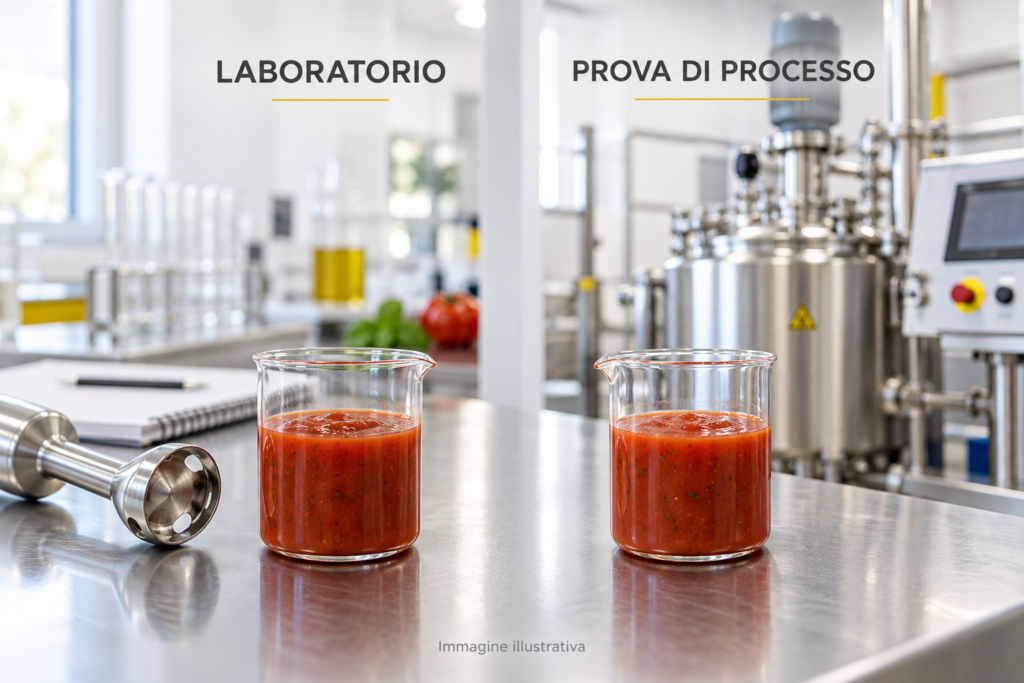

Sauce samples compared following a recipe scale-up trial.

How to calculate output across the complete production cycle

Equipment capacity should be assessed against the quantity that can actually be produced during a shift. The calculation needs to include ingredient preparation, loading, processing, discharge, waiting periods, cleaning and recipe changeovers.

Distinguish sequential tasks from operations that can run in parallel. Preparing the next batch while the current batch is processing, for example, affects the organisation of production and its overall timing.

Cleanability should be considered during equipment design. The EHEDG Hygienic Design Principles explain the relationship between design and ease of cleaning. Cleaning procedures need to be defined and verified for the products and operating conditions involved.

The INOX-FER checklist of 10 questions before investing in a new food processing plant helps bring these considerations into the purchasing decision.

What to share with an equipment supplier

Prepare the formulation, a reference sample and a description of the current process. Add the intended production volumes, the characteristics to preserve and the factory constraints.

Include any problems already observed, such as lumps, long processing times or differences between batches. This information helps focus the technical assessment and identify the trials required.

Planning to move a recipe into industrial production or increase your output? Contact the INOX-FER team to discuss your process, required volumes and equipment configuration.

FAQ – Frequently asked questionsabout food process scale-up

Keeping the proportions unchanged preserves the formulation, but does not guarantee the same result. Larger batches change mixing and heat transfer conditions. Ingredient addition sequence, processing intensity, temperatures and times must therefore be assessed, comparing the finished product against the agreed specifications for consistency, uniformity and stability.

Provide the formulation, ingredient characteristics, loading sequence, temperatures and processing times used in the current process. Also specify minimum and maximum batch sizes, required daily output and finished product specifications. Reference samples, details of existing equipment and factory constraints help define the trials and equipment configuration.

One successful trial confirms the result of that particular cycle. Assessing repeatability requires several batches under defined conditions, recording process parameters and comparing results against agreed acceptance criteria. The number of trials depends on the product, raw material variability and the objectives of the assessment.

Yes, if its working volumes and performance meet the new process requirements. The assessment should cover mixing, heating and cooling, discharge, cleaning and integration with filling equipment. A trial using the recipe can help establish whether the equipment is suitable, requires modifications or needs to be replaced with a dedicated solution.

Compare samples from industrial batches with a reference product using agreed test methods and conditions. Checks may cover consistency, uniformity, colour, sensory characteristics and stability. Comparisons should take place at relevant stages, such as after cooling, transfer or storage.

Capacity should reflect the quantity required per shift and the duration of the complete production cycle. Include ingredient preparation, loading, processing, discharge, cleaning and recipe changeovers. The vessel’s nominal volume alone does not indicate the output achievable in practice.

Not necessarily. Before adjusting the formulation, check whether differences result from mixing conditions, ingredient addition sequence, temperatures or processing times. Any recipe changes should be assessed with R&D and confirmed through trials, checking their effects on the finished product.

Author

Matteo Morotti rotated

Matteo Morotti is a Process Engineer at INOX-FER, an Italian manufacturer of stainless steel process equipment for the food industry. He contributes an engineering perspective to articles on food processing systems and the technical requirements that influence equipment design.