Sommario
Industrial ice cream production is a highly controlled process that combines advanced technology, precise ingredient formulation, and automated equipment. Each stage of the process is designed to ensure consistent product quality, food safety, and high production efficiency.
Ice cream is a multiphase system composed of water, sugars, fats, proteins, and air. Its structure depends on the balance between ice crystals, fat emulsions, and air bubbles uniformly distributed during processing, as also described in the scientific literature on complex food systems, for example in studies on ice cream microstructure available in open access on
Materials (MDPI) – Ice Cream Microstructure Study and on Food Hydrocolloids – Ice Cream Microstructure and Structure Types.
Ingredients and Composition in Ice Cream Production
A well-balanced formulation is essential in any industrial ice cream production process, as it directly affects texture, stability, and flavor.
Key Ingredients
- Water: the base phase that impacts freezing behavior
- Sugars: control sweetness and freezing point
- Fats: provide creaminess and structure
- Milk proteins: stabilize the emulsion
- Air (overrun): critical for texture and volume – key element for ice cream production
Functional Ingredients
- Stabilizers: enhance texture and shelf life
- Emulsifiers: improve fat distribution
- Flavorings: define the taste profile
Stages of the Industrial Ice Cream Production Process
Industrial ice cream production is structured as a sequence of precise processing steps, which together constitute the complete ice cream production process.
1 - Raw Material Handling and Storage
Raw materials are subjected to quality control checks and stored under appropriate conditions. This initial stage is essential to ensure safety and quality throughout the entire production line.
2 - Mixing and Blending
The ingredients are precisely dosed and then mixed until a homogeneous blend is obtained. This stage is crucial to ensure an even distribution of all components.
3 - Homogenization
Through high-pressure equipment, fat globules are reduced in size. This process improves emulsion stability and contributes to a finer, creamier texture.
4 - Pasteurization
The mixture is heated (around 83–85 °C) to eliminate pathogenic microorganisms and ensure food safety, in line with the international food safety guidelines of the 👉Food and Agriculture Organization.
5 - Aging
During maturation, the mixture is kept at a controlled temperature to promote ingredient hydration and improve viscosity and structure.
6 - Freezing and Aeration
The mixture is cooled under continuous agitation. During this phase, ice crystals form and air is incorporated, determining the final structure of the ice cream.
8 -Hardening
The product is rapidly brought to low temperatures to stabilize its structure and ensure preservation during distribution and storage.
Industrial Ice Cream Equipment and Production Lines
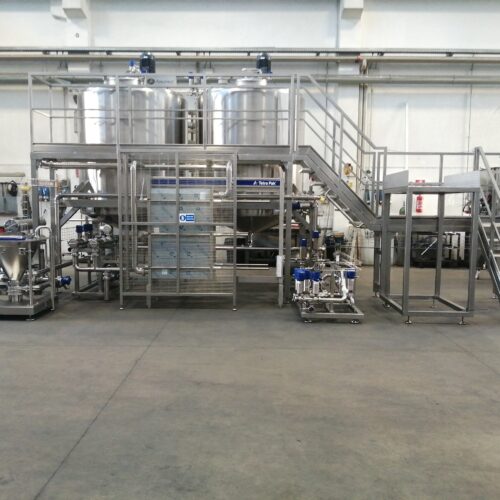
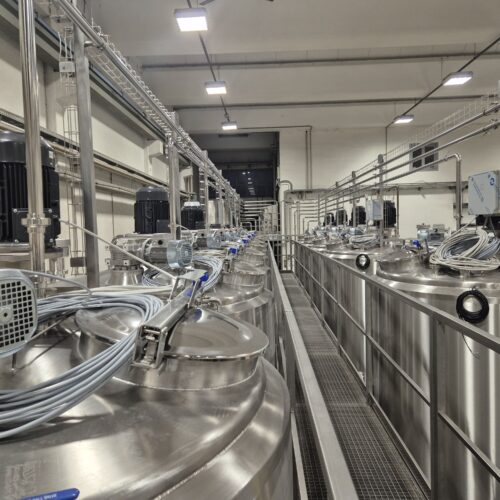
Modern industrial ice cream equipment is designed to optimize every stage of the production process, ensuring efficiency, consistency, and scalability.
Main Equipment Used in Ice Cream Manufacturing
- Ingredient dissolvers and mixers
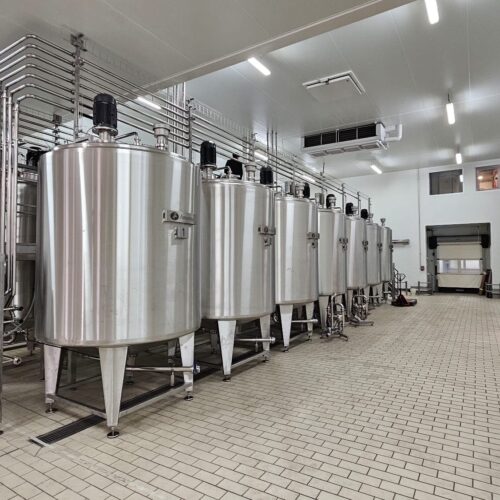
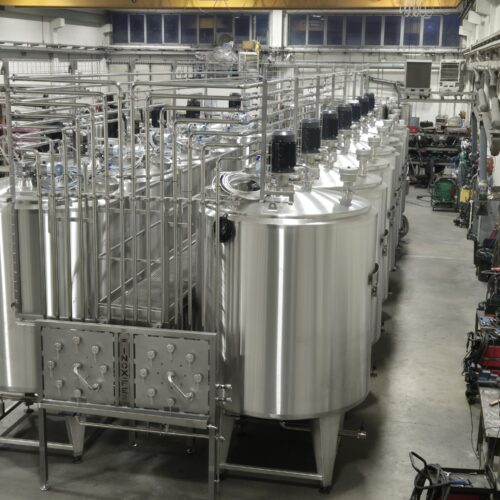
- Preparation tanks with pumping systems
- High-pressure homogenizers
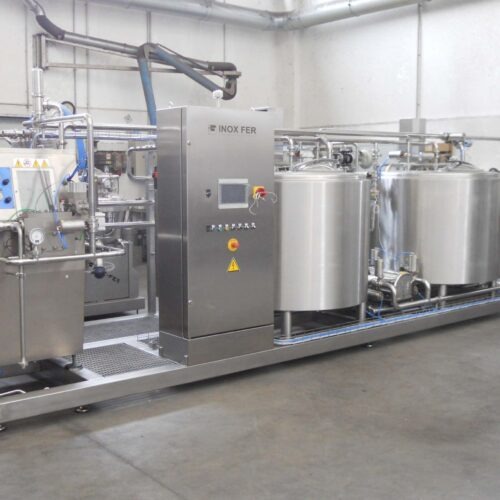
- Pasteurizers with heat exchangers
- Rapid cooling and freezing systems
- Fully automated production lines for continuous processing
How to Optimize an Ice Cream Production Line
Investing in advanced ice cream production equipment helps manufacturers improve productivity, reduce energy consumption, and maintain high quality standards.
An optimized production line also allows precise control of critical process parameters, increasing operational efficiency and market competitiveness.


FAQ - Industrial Ice Cream Production
1. How is industrial ice cream made?
Industrial ice cream is produced through several stages: mixing, homogenization, pasteurization, aging, freezing, and hardening.
2.What equipment is used in ice cream manufacturing?
The main industrial ice cream machinery includes mixers, homogenizers, pasteurizers, and cooling systems.
3. What is overrun in ice cream production?
It is the amount of air incorporated during churning, a fundamental parameter in ice cream production technology.
4. Why is pasteurization important in ice cream production?
It is an essential stage of the industrial ice cream process to ensure food safety and product stability.
5. Why is an efficient production line important?
An optimized production line reduces costs, improves consistency, and ensures high-quality output